DateRangeEdit

DateRangeEdit — single unified control for picking a DateRange.
Public functions
DateRangeEdit
Detailed description
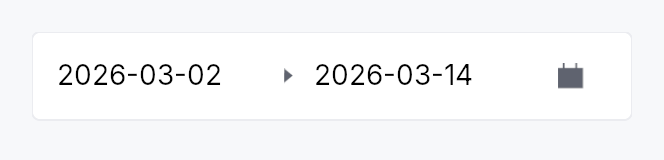
Visually one widget: a single bordered frame containing two
TextInputField halves separated by a painted arrow glyph, with
a trailing built-in calendar button that opens a shared
Calendar::range popover. Backed by Signal<Option<DateRange>>.
┌──────────────────────────────────────┐
│ 05/12/2026   →   05/19/2026   │ 📅  │
└──────────────────────────────────────┘
Why one frame?
Two adjacent DateEdits (one frame each) visually read as two
separate fields that happen to be next to each other. A single
frame says "this is one range". Same affordance the user is used
to from booking sites and analytics dashboards.
Behaviour
- Two text halves — each masked from the resolved date pattern,
each with its own validator + segment-stepping (Up/Down on the
focused segment matches
DateEdit). - Painted arrow separator — a thin chevron-right glyph, no text.
Visual only; AT users see the wrapper's
Role::DateInput. - One trailing calendar button — Int UI
IconButton::embedded()with the calendar glyph. Opens a single popover hostingCalendar::rangebound to the outer signal. The two-anchor click model (start-then-end) commits the range and closes the popover. No per-half calendar buttons — there's only one calendar, anchored to the wrapper. - One frame — focus-aware border (
BorderRole::Focusedwhile any half holds focus, otherwiseDefault), validation-aware border (ErrorforInvalid,FocusedforCorrected). - One validation strip below the frame — composed feedback from both halves (worse of the two wins).
Accessibility
- Container:
Role::DateInput, its value the two days in full joined by words in the tree's locale ("du vendredi premier mai 2026 au mardi 5 mai 2026", "Friday, May 1, 2026 to Tuesday, May 5, 2026"), the samecalendar-date-rangemessage the range calendar speaks. - Each
TextInputFieldcarries its own AT node, aRole::TextInputnamed for its half ("Start date", "End date"); the wrapper'sRole::DateInputprovides the range semantics. A half re-roledRole::DateInputreached Orca as a date editor, which it reads without its text. - The calendar opens on the start the field holds, on its days, with no range begun, whatever an earlier opening left.
// Requires ctx.signal() — shown as ignore per convention.
use teksilo_widgets::date_range_edit::DateRangeEdit;
use jiff::civil::Weekday;

let range = ctx.signal(None);
let _w = DateRangeEdit::new(range.clone())
    .first_day_of_week(Weekday::Monday)
    .on_value_changed(|r, _ctx| println!("{r:?}"));
Touch and pen
See DateEdit's "Touch and pen" section.
Density
The picture above is the widget at TargetDensity::Compact, the mouse-and-keyboard ladder. Below is the same subject on the same canvas with only the ladder changed, so what moves is the density and nothing else — where the subject no longer fits, that is what the denser targets cost it at that size. See docs/density-and-targets.md.
Touch
API reference
📖 Full rustdoc API for this module
pub struct DateRangeEdit
Import: use teksilo::widgets::DateRangeEdit;
Two-handle date picker over Signal<Option<DateRange>>. See the
module docs for the visual layout and behaviour.
#![allow(unused)]
fn main() {
pub struct DateRangeEdit { /* fields */ }
}
Methods
pub fn new(value: Signal<Option<DateRange>>) -> Self
Create a date-range picker bound to value.
pub fn style(mut self, style: impl teksilo_core::styles::DateEditStyle) -> Self
Per-call DateEditStyle override (shared with DateEdit family).
pub fn min_date(mut self, d: Date) -> Self
Restrict the selectable start and end dates to those on or after d.
pub fn max_date(mut self, d: Date) -> Self
Restrict the selectable start and end dates to those on or before d.
pub fn format_pattern(mut self, p: impl Into<String>) -> Self
Override the strftime-subset format pattern for both halves
(e.g. "%d/%m/%Y"). Defaults to the locale-derived pattern.
pub fn placeholder_start(mut self, text: impl Into<LocalizedString>) -> Self
Placeholder shown in the start half when no date is set.
pub fn placeholder_end(mut self, text: impl Into<LocalizedString>) -> Self
Placeholder shown in the end half when no date is set.
pub fn first_day_of_week(mut self, w: Weekday) -> Self
Override which weekday appears in the first column of the calendar popup.
pub fn enabled(mut self, enabled: impl Into<Prop<bool>>) -> Self
Set the enabled state, statically or reactively. Forwarded to the arena at build time.
pub fn read_only(mut self, read_only: bool) -> Self
Make both halves read-only; the calendar button is also disabled.
pub fn label(mut self, label: impl Into<LocalizedString>) -> Self
Accessible label for the wrapper Role::DateInput node. When not set,
falls back to the localized date-range-edit-name message.
pub fn validation_behavior(mut self, behavior: ValidationBehavior) -> Self
How both halves handle invalid or out-of-range text on blur / Enter.
Defaults to ValidationBehavior::AutoCorrect.
pub fn end_width_policy(mut self, policy: crate::date_edit::WidthPolicy) -> Self
How the trailing (end) half claims horizontal space. The
leading (start) half always sizes to its natural mask width;
the end half follows this policy. Default
WidthPolicy::Default (natural width); pass
WidthPolicy::Fill to make the end half absorb extra
space the parent offers.
pub fn tooltip(mut self, text: impl Into<LocalizedString>) -> Self
Show a plain single-line tooltip on hover. Mutually exclusive with the rich / composite tooltip slots — this setter clears the other two so the last call wins.
pub fn rich_tooltip(mut self, key: impl Into<String>) -> Self
Show a rich tooltip sourced from the registry by key. Mutually
exclusive with the plain / composite tooltip slots — this setter clears
the other two so the last call wins.
pub fn rich_tooltip_content(mut self, content: crate::tooltip::TooltipContent) -> Self
Show a rich tooltip from an inline TooltipContent value. Mutually
exclusive with the plain / registry-key tooltip slots — this setter
clears the other two so the last call wins.
pub fn composite_tooltip(mut self, content: impl Widget + 'static) -> Self
Show a composite tooltip whose body is an arbitrary widget tree. Mutually exclusive with the plain / rich tooltip slots — this setter clears the other two so the last call wins.
pub fn validation_feedback_signal(&self) -> Signal<ValidationFeedback>
Reactive handle on the composed validation feedback (worse of the two
halves — Invalid > Corrected > Valid > Pristine).
pub fn on_value_changed( mut self, f: impl Fn(Option<DateRange>, &mut EventContext) + 'static, ) -> Self
Callback invoked whenever the range changes (including when one half
clears its value). Receives the new Option<DateRange> and an
EventContext for dispatching intents or side effects.
pub fn value(&self) -> Signal<Option<DateRange>>
Clone the underlying Signal<Option<DateRange>> for external binding.