Padding
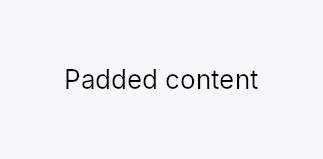
Padding — a single-child layout container that adds insets around its child.
Public functions
Padding
Detailed description
Padding shrink-wraps a child widget and enlarges it by configurable insets
on each of the four sides. Horizontal insets are leading/trailing
(logical), not left/right (physical), so they flip automatically in RTL
locales. Each inset accepts a static f32 or a reactive Signal<f32>; a
bound inset schedules a relayout whenever the signal fires, so theme-derived
spacing values take effect without rebuilding the widget tree.
The grow weight, shrink weight, and compression floor reported by the child
are forwarded through the padding so a flexible or shrinkable child inside a
Padding stays flexible or shrinkable from the parent's perspective.
When to use
- Adding whitespace around a widget without wrapping it in a stack.
- Applying asymmetric insets (e.g. extra leading inset for a list item).
- Reacting to a
Signal-driven spacing token.
Use Padding::uniform when all four sides are equal, and
Padding::symmetric when horizontal and vertical insets differ.
#![allow(unused)]
fn main() {
use teksilo_widgets::primitives::{Padding, TextWidget};
use teksilo_i18n::lit;
// 12 dp padding on every side:
let _w = Padding::uniform(12.0)
    .child(TextWidget::new(lit!("Hello")));
}
Density
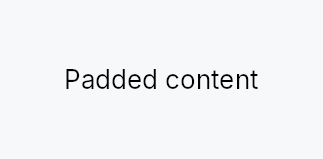
The picture above is the widget at TargetDensity::Compact, the mouse-and-keyboard ladder. Below is the same subject on the same canvas with only the ladder changed, so what moves is the density and nothing else — where the subject no longer fits, that is what the denser targets cost it at that size. See docs/density-and-targets.md.
Touch
API reference
📖 Full rustdoc API for this module
pub struct Padding
Import: use teksilo::widgets::Padding;
A layout container that adds padding (insets) around a single child.
See the module documentation for the full feature description and
an example. Construct with Padding::new, Padding::uniform, or
Padding::symmetric; attach a child with .child(widget) or
.child(id).
#![allow(unused)]
fn main() {
pub struct Padding { /* fields */ }
}
Methods
pub fn new( top: impl Into<Prop<f32>>, trailing: impl Into<Prop<f32>>, bottom: impl Into<Prop<f32>>, leading: impl Into<Prop<f32>>, ) -> Self
Create a padding with explicit per-side insets.
Argument order mirrors CSS shorthand: (top, trailing, bottom, leading).
trailing and leading are logical — they map to physical right and
left in LTR and are swapped in RTL.
pub fn uniform(amount: impl Into<Prop<f32>>) -> Self
Create a padding with the same inset on all four sides.
pub fn symmetric(vertical: impl Into<Prop<f32>>, horizontal: impl Into<Prop<f32>>) -> Self
Create a padding with equal top/bottom insets and equal leading/trailing insets.
vertical applies to both top and bottom; horizontal applies to both
leading and trailing sides (logical, RTL-aware).
pub fn child(mut self, widget: impl teksilo_core::IntoTeksiChild) -> Self
Set an inline child widget (deferred insertion).
pub fn child_opt(self, widget: Option<impl teksilo_core::IntoTeksiChild>) -> Self
Attach widget when it is Some, and do nothing when it is None.
The conditional-child form. teksu!'s if without an else lowers to
this, and it is what cond.then(|| w) is for in a builder chain. None
adds no arena node, so nothing is laid out, painted, or published to the
accessibility tree, and a stack applies no spacing around it.