TreeTableView
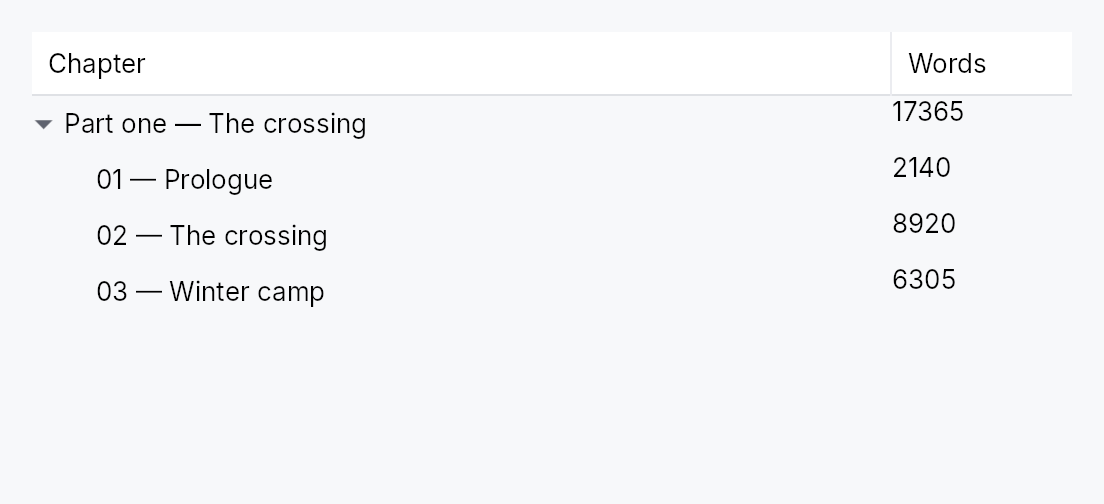
TreeTableView<T> — hierarchical multi-column data table with expand/collapse.
Public types
| Kind | Name |
|---|---|
struct | TreeTableView — Hierarchical multi-column widget |
struct | TreeTableViewHandle — A handle on a mounted TreeTableView, to scroll it to a row from outside the widget — a view-model revealing the node a search found, say |
Public functions
TreeTableView
TreeTableViewHandle
| Returns | Function |
|---|---|
| Methods | |
scroll_to_row(row: usize) | |
ensure_row_visible(row: usize) |
Detailed description
Sibling of TableView for tree-shaped data. Each row carries
a depth level; one designated column (the tree column, defaulting to the first)
shows a twist (chevron) and an indent gutter that toggles the row's children.
Backed by a SortFilterTreeModel<T> so sort, filter, and expand state compose
without extra bookkeeping. Shares the header (a hosted
TableHeader), column, keyboard, and selection
modules with TableView.
Rows live in a TreeBodyPane — a sibling of the scrollbar — so buffer-exit /
selection / expand rebuilds are never deferred mid-thumb-drag. Three row-height
modes: uniform (row_height, fast path), exact per-flat-index callback
(row_height_fn), and auto-measured (auto_row_height — grows to tallest cell).
Common patterns
A checkbox column. Selection and "checked" are different things — a
checkbox column wants its own state, with parent/child propagation. Build it
from TreeCheckedModel over the same tree
the view projects.
A cell delegate receives (&T, &CellContext) and CellContext carries no
node identity — only row_index. So
capture the projection and resolve the row's NodeId through it:
let proxy = SortFilterTreeModel::new(tree);
let checks = TreeCheckedModel::new(proxy.tree());
let for_cells = proxy.clone();
let col = Column::new("done", lit!("Done"), move |_item, cx: &CellContext| {
    match for_cells.visible_node_id(cx.row_index) {
        Some(node) => Box::new(Checkbox::new(checks.check_state(node))) as Box<dyn Widget>,
        None => Box::new(Spacer::new()),
    }
});
For a tree whose identity is a domain key rather than a NodeId, use
KeyedTreeCheckedModel instead — it
survives a full re-source, which a NodeId-keyed set cannot.
Group rows that span the table, and the group kept in sight. A tree
whose upper levels are groups — songs under albums under artists — draws
those rows as one band across every column with
full_width_row and
full_width_row_delegate, and
keeps the groups being scrolled through pinned under the header with
pinned_ancestors:
let view = TreeTableView::from_projection(proxy)
    .columns(columns)
    .full_width_row(|row: &Row| !row.is_song())
    .full_width_row_delegate(|row, _cx: &CellContext| {
        Box::new(TextWidget::new(lit!(row.summary()))) as Box<dyn Widget>
    })
    .pinned_ancestors(2); // the artist, then the album
A band is still a row of the tree — it selects, drags, expands from its chevron and answers type-ahead — and one cell to the keyboard and to assistive technology. The pinned rows are copies, pushed up as the next group arrives, hidden from assistive technology, and every reveal stops below them. The two builders say the rest.
Accessibility
Root emits Role::TreeGrid; rows carry set_level + set_expanded.
ArrowLeft / ArrowRight on the tree column collapse / expand. A full-width
row holds one cell, spanning every column.
// Column delegates capture closures — use ignore.
use teksilo_widgets::TreeTableView;
use teksilo_data::TreeModel;
# struct File { name: String }
# let model: TreeModel<File> = TreeModel::new();
let _view = TreeTableView::new(model).row_height(28.0);
Scrolling to a row
handle returns a TreeTableViewHandle, a
cheap Clone taken before the view is added and usable from any handler
afterwards. Its scroll_to_row and
ensure_row_visible take a flat
visible row index and are applied at the next layout pass, after row
measurement and scroll anchoring, so they may follow an expansion in the
same turn, or be called before mount:
#![allow(unused)]
fn main() {
use teksilo_data::TreeModel;
use teksilo_widgets::TreeTableView;
let model: TreeModel<String> = TreeModel::new();
let view = TreeTableView::new(model);
let handle = view.handle();
// … add the columns, `ctx.add(view)`; then, from a handler, after
// expanding the row's ancestors in the same turn:
handle.ensure_row_visible(42);
}
The builder-value methods of the same names compute the offset when they are called, against the last layout pass.
Pan to scroll
The view installs common::scrollable::ScrollableBehavior,
which gives it the shared wheel arithmetic, a finger's pan and the
PanClaim that puts it on a pan's claimant chain. A pan scrolls it, the
release coasts, and a pan it cannot absorb hands the whole event to the
container outside — never a residual. A pan that starts on a row scrolls
rather than activating it or collapsing a multi-selection onto it. Both axes
are claimed. Shift+wheel still
scrolls the columns, and a finger's pan is never remapped by a held Shift:
the remap is a wheel convention, and turning a drag sideways is not what
the hand asked for.
Density
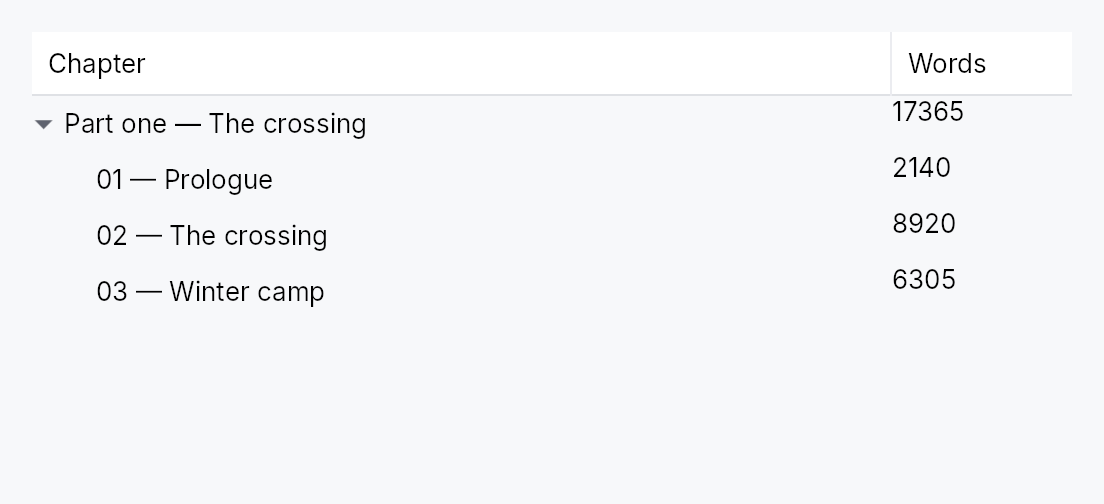
The picture above is the widget at TargetDensity::Compact, the mouse-and-keyboard ladder. Below is the same subject on the same canvas with only the ladder changed, so what moves is the density and nothing else — where the subject no longer fits, that is what the denser targets cost it at that size. See docs/density-and-targets.md.
Touch
API reference
📖 Full rustdoc API for this module
pub struct TreeTableView
Import: use teksilo::widgets::TreeTableView;
Hierarchical multi-column widget. See module documentation.
#![allow(unused)]
fn main() {
pub struct TreeTableView<T: 'static> { /* fields */ }
}
Methods
pub fn from_projection(proxy: SortFilterTreeModel<T>) -> Self
Wrap a SortFilterTreeModel<T>.
pub fn from_source<S: TreeDataSource<Item = T> + 'static>(source: S) -> Self
Build a tree table over any TreeDataSource — an external source of
truth (an entity store, a database, a virtual filesystem) carrying
its own Key, so it needs no TreeModel mirror.
This is the tree-table sibling of
TreeView::from_source. Because the
source owns identity, its expand state (and a keyed selection) survive a
full re-source — which a TreeModel mirror cannot guarantee, since
NodeIds are reassigned on rebuild.
The NodeId-typed methods (expand,
projection, keyed_selection)
do not apply here and no-op; drive expansion through the source itself.
Row drag-reorder is wired on this path: a drop routes through the source's
own drag / can_accept / accept_drop, exactly as
TreeView does — so the
source owns both the cycle guard and the commit. Note that
TreeDataSlice::drag defaults to NoDrag: an
external source must opt its rows in before anything can be dragged.
pub fn from_source_keyed<S: TreeDataSource<Item = T> + 'static>( source: S, keyed: KeyedSelectionModel<S::Key>, ) -> Self where S::Key: teksilo_data::ItemKey,
Like from_source but with keyed selection:
the KeyedSelectionModel<S::Key> tracks rows by source identity, so it
survives expand / collapse, sort / filter and a full re-source. Pruning
consults the source's contains_key, so a collapsed-but-present row
keeps its selection. The view stays TreeTableView<T> — the Key is
captured here.
pub fn new(model: TreeModel<T>) -> Self
Wrap a raw TreeModel<T> — convenience for callers that don't
need sort/filter. Internally builds an identity
SortFilterTreeModel.
pub fn enabled(mut self, enabled: impl Into<Prop<bool>>) -> Self
Enable or disable the whole view. A disabled view greys out and stops accepting focus / selection / keyboard input (arena-gated).
pub fn overscroll_behavior(mut self, behavior: OverscrollBehavior) -> Self
Set the scroll-chaining behavior at the boundary (default
OverscrollBehavior::Chain; Contain
disables chaining to an ancestor scrollable).
pub fn smooth_scrolling(mut self, enabled: bool) -> Self
Enable or disable animated wheel scrolling (enabled by default). When disabled, wheel events snap immediately to the new offset.
pub fn type_ahead_label(mut self, label: impl Fn(&T) -> String + 'static) -> Self
Enable type-ahead ("type to jump"): typing a printable character
while the tree-table has keyboard focus jumps the focused row to the
next visible row whose label starts with the accumulated search term,
wrapping around (Qt keyboardSearch / macOS & Windows type-select).
label(&item) yields the searchable text; matching is
ASCII-case-insensitive. A pause longer than the
type_ahead_timeout starts a fresh term.
pub fn type_ahead_timeout(mut self, timeout: Duration) -> Self
Reset window between keystrokes before the type-ahead search term clears (default 500 ms). A zero duration disables type-ahead.
pub fn smooth_scroll_duration(mut self, duration: Duration) -> Self
Duration of the smooth scroll animation (default 150 ms).
pub fn scroll_bar_style(mut self, style: ScrollBarMode) -> Self
How the scroll bar is displayed (default Permanent). Overlay
and Thin float the bar over the content instead of reserving a
layout column for it, mirroring ScrollArea::scroll_bar_style.
pub fn add_column(mut self, col: Column<T>) -> Self
Append a column definition. Columns are displayed in declaration order unless reordered by the user.
pub fn reorderable(mut self, enabled: bool) -> Self
Enable drag-to-reorder of rows (pointer drag + keyboard
Alt+ArrowUp/Down). Distinct from
Column::reorderable, which reorders
columns and defaults to true; this defaults to false.
A drop reparents/reorders the dragged node in the underlying
TreeModel (top third of a row = Before, middle = Into / make-child,
bottom = After). The move is cycle-guarded — dropping a node onto
itself or into its own subtree is refused (no insertion line). Reorder
is suppressed while the view is sorted by one of its own columns:
with the visible order driven by the sort, a manual reorder would have
no visible effect. A sort a shared bind_sort
holds for a column this view lacks does not count.
pub fn exportable(mut self, mode: DragTransferMode) -> Self where T: Clone,
Make rows droppable outside this view — on a
DropTarget, another data view, or the OS.
A dragged row (or the whole selection, when the pressed row is part of a
multi-selection) carries clones of its items in a public
RowDragData<T>, so a foreign receiver can pull
them out with payload.get_typed::<RowDragData<T>>() /
DropTarget::on_drop_typed::<RowDragData<T>>() — no serialization. This
also makes rows a drag source even without reorderable.
mode chooses what happens to the origin rows once a foreign target
accepts them: DragTransferMode::Move removes them — by default,
directly from the underlying TreeModel (any dragged node that is a
descendant of another dragged node is skipped, since removing the
ancestor already removes it); override via
on_rows_transferred_out.
DragTransferMode::Copy leaves them. A same-view reorder is never a
transfer, so mode never affects it. Requires T: Clone.
pub fn export_external(mut self, f: impl Fn(&[T]) -> Vec<(String, Vec<u8>)> + 'static) -> Self where T: Clone,
Additionally advertise the dragged rows as MIME data so they can be
dropped on a DropZone or exported to another
application / window via the OS. f maps the dragged items to
(mime_type, bytes) pairs (e.g. text/plain, text/uri-list, an
app-specific application/x-…). Implies exportable
(defaulting to DragTransferMode::Move if not already set). Requires
T: Clone.
pub fn on_rows_transferred_out( mut self, f: impl Fn(&[usize], &mut EventContext) + 'static, ) -> Self
Override how rows moved out to a foreign target are removed from this
view. Receives the dragged rows' flat visible indices (as captured at
drag-start) and the live context. Without this, an
exportable Move drag
removes the dragged nodes directly from the underlying TreeModel
(leaf-first / descending — a dragged node that is a descendant of
another dragged node is skipped, since removing the ancestor already
removes its whole subtree).
pub fn accept_foreign_rows(mut self, accept: bool) -> Self
Accept exported rows dropped from a different view or source
without writing a custom source. Pair with
on_rows_received, which is handed the
dropped items and the target flat row index. (Same-view reorder is
reorderable.)
pub fn on_rows_received( mut self, f: impl Fn(Vec<T>, usize, &mut EventContext) + 'static, ) -> Self
Handler for rows accepted via
accept_foreign_rows: (items, target flat row index, ctx). Insert them into your tree at/near the index.
pub fn on_foreign_drop( mut self, f: impl Fn(&DragPayload, NodeId, DropPosition, &mut EventContext) -> bool + 'static, ) -> Self
Raw escape hatch for a foreign drop.
Projection path only. This hook is NodeId-typed and predates
from_source; over an external source there is no
NodeId to hand it, so it never fires. Prefer
accept_foreign_rows +
on_rows_received, which are source-agnostic.
A source-backed view expresses foreign-accept through its source's own
capability closures (can_accept / accept_drop), like ListView /
TableView; this hook is what a projection-backed view has instead,
since a SortFilterTreeModel carries no such closures.
This fires for any payload NOT recognized as this view's own row
drag — a different view's RowDragData<T>, or a
completely different payload type — dropped on a node: (payload, target node, drop position, ctx) -> accepted. Tried after
on_rows_received, so the typed sugar wins
when both are set and the payload happens to carry an exportable
RowDragData<T>.
pub fn activate_on(mut self, mode: crate::data_views::ActivateOn) -> Self
Choose single- vs double-click activation for on_row_activate (default
ActivateOn::DoubleClick). Enter/Space activates in
either mode.
pub fn columns(mut self, cols: impl IntoIterator<Item = Column<T>>) -> Self
Append multiple columns from an iterator.
pub fn tree_column(mut self, col_id: impl Into<String>) -> Self
Designate which column hosts the twist + indent. Default: the first column.
pub fn indent_per_level(mut self, px: f32) -> Self
Override the per-depth indent in the tree column in logical pixels (default
comes from the active TableStyle).
pub fn full_width_row(mut self, is_full_width: impl Fn(&T) -> bool + 'static) -> Self
Draw the rows whose item satisfies is_full_width as one cell across
every column instead of a cell per column: a group row ("an artist ·
12 songs | 3 albums | 52:10") over rows that fill the columns. What the
band shows comes from
full_width_row_delegate; without one
it shows the tree column's own cell, laid across the row.
Asked of the item, like the cell delegates; a row whose item is still loading is never full-width. The predicate is read on every build and on every key press, so keep it to a field test.
The row stays a row of the tree in every other respect: it selects, activates, drags, takes drops and answers type-ahead as any row does, its chevron (indent and twist) sits in the band, and ←/→ act on it as on the tree column from any column: they collapse and expand it, and ← on a collapsed band moves up to its parent. In cell navigation the band is one cell: Home and End stay on it, Tab passes it as one stop, and no column of it opens an editor. The cursor keeps the column it arrived with, so stepping on to an ordinary row lands back in that column.
The band is as wide as the columns together, or the row when they are
wider, so beside columns narrower than the view it ends where a row's
selection band, alternating tint and focus ring do. It stays in the
viewport while the columns
scroll sideways, so a group row stays readable; its chevron sits where
the tree column's does with the columns unscrolled. Its height comes
from the view's height mode like any row's: the uniform height, the
row_height_fn callback, or, under
auto_row_height, the band measured at its
width.
To assistive technology the row is unchanged (Role::Row with its
level, expanded state and position) and holds one Role::Cell
(Role::GridCell in the cell modes) at column 1, with a column span of
every column and the band as its content.
pub fn full_width_row_delegate( mut self, delegate: impl Fn(&T, &CellContext) -> Box<dyn Widget> + 'static, ) -> Self
Build the band of a full_width_row from its
item, as a Column's delegate builds a cell. The context describes
the band as the tree column, whose chevron it carries: col_id and
col_index are the tree column's and is_tree_column is true;
is_focused holds while the cursor is on the row, in any column, and
is_selected while the row is selected (in a cell mode, while any of
its cells is). The indent and the chevron are drawn before the
delegate's widget, as in the tree column.
Does nothing without full_width_row, which
says which rows get it.
pub fn pinned_ancestors(mut self, depth: usize) -> Self
Keep the ancestor rows of the first visible row pinned under the
header while the view scrolls, outermost first and at most depth
levels of them: the "sticky scroll" of code editors, the artist and
then the album over the songs. 0 (the default) pins nothing.
A pinned row is pushed up by the next row at its level as that row
arrives, as a pinned section header is, so it never covers a row it is
not an ancestor of. It is a copy, drawn with the real row's cells (its
band, for a full_width_row) at the real row's
height, on the header's surface. The copy shows the row's content, not
its selection or its focus, and its chevron is a picture. Under
auto_row_height the copy measures the row,
as the row does once laid out: an ancestor the view scrolled past
without laying it out takes its height a frame after it is pinned, and
a reveal made before then counts it at the estimate.
A press on a pinned row does what a plain click on the real row would:
it ends an open cell edit, selects the row and puts the cursor on it,
activates it under ActivateOn::SingleClick,
and scrolls it back into view, right under its own pinned ancestors. A
double click on a copy does not activate it, and a press never reaches
a control drawn inside the copy. A drop on a pinned row lands on the
row it shows, and its indicator is drawn over the copy.
Every reveal the view makes (the keyboard moving the cursor,
ensure_row_visible,
scroll_to_row, taking focus, the
ScrollIntoView action) stops below the ancestors that would be pinned
over the row, so a copy never covers the row the cursor is on.
The copies are hidden from assistive technology and are not focusable; the real rows stay where they are in the tree, scrolled under the copies like any row off the top. The stack is re-derived on every layout, so an expand, a collapse, an insert or a re-source above or inside it shows on the next frame.
pub fn row_height(mut self, height: f32) -> Self
Fixed row height, the uniform fast path. Default: the active
TableStyle's
row_height, 28 px
under IntUI at the Compact density. Mutually exclusive with
row_height_fn and
auto_row_height; the last mode setter
wins.
pub fn row_height_fn(mut self, f: impl Fn(usize) -> f32 + 'static) -> Self
Per-row heights from a callback over the flat (visible) row index. The callback must be pure (same index + same data → same height); it is re-swept from the first changed flat index on every projection rebuild (expand/collapse/sort/filter/mutation). No measurement pass runs.
pub fn auto_row_height(mut self, estimated: f32) -> Self
Auto-measured row heights: each realized row reports the height
of its tallest cell measured at the cell's column width
(height-for-width), unrealized rows assume estimated. Scroll
anchoring keeps content above the viewport stationary; measured
heights above a toggled row survive expand/collapse
(divergence-driven invalidation). The scrollbar settles one
frame after a measurement change.
pub fn header_height(mut self, height: f32) -> Self
Override the header row height in logical pixels. Default: the active
TableStyle's
header_height,
32 px under IntUI at the Compact density.
pub fn show_header(mut self, visible: bool) -> Self
Show or hide the column header row (default true).
pub fn selection_mode(mut self, mode: TableSelectionMode) -> Self
Set the row/cell selection mode (default
TableSelectionMode::MultiRow).
pub fn selection(mut self, sel: SelectionModel) -> Self
Set the index-based row selection model (visible positions). For
identity-based selection that survives expand / collapse / sort /
filter / structural edits, use keyed_selection
instead.
pub fn keyed_selection(mut self, keyed: KeyedSelectionModel<NodeId>) -> Self
Set a keyed row selection model (by NodeId). Selection is tracked by
node identity, so it survives expand / collapse, sort / filter, and node
moves — and stays consistent if two views share the projection. Pruned
of deleted nodes on each projection change. Mutually exclusive with
selection (last one set wins).
Only meaningful on the from_projection /
new paths, whose identity is NodeId; a no-op over an
external source, which carries its own key — use
from_source_keyed there.
pub fn cell_selection(mut self, sel: CellSelectionModel) -> Self
Attach a cell-level selection model (row and column axes tracked independently).
pub fn alternating_rows(mut self, enabled: bool) -> Self
Paint odd-indexed rows with the SurfaceRole::AlternatingRow tint
(default false).
pub fn grid_lines(mut self, kind: GridLines) -> Self
Paint horizontal and/or vertical dividers between cells.
pub fn stretch_last_column(mut self, on: bool) -> Self
Let the last column in display order take up whatever width the
other columns leave, so the table never ends in a bare strip at its
trailing edge — Qt's stretchLastSection, NSTableView's
lastColumnOnlyAutoresizingStyle. Default: off.
Positional, not a property of a column: after a reorder it is the new last column that stretches and the previous one goes back to its own width. While a column stretches, its declared width is the floor it grows from, its user-resize override is ignored, and its trailing grip is disabled (no AccessKit Increment/Decrement either): any size the user gave it, the stretch would take straight back. Resizing any other column reflows it. Once the other columns exceed the viewport there is nothing left to stretch into — the last column sits at its own width and the pane scrolls, as in Qt.
Flex columns already share every spare pixel among themselves, so
a table of Flex columns looks the same either way: this is for
pixel-sized tables (Fixed / Auto, or widths the user has set)
that would otherwise end in a gap.
pub fn a11y_label(mut self, label: impl Into<LocalizedString>) -> Self
Accessible label for the whole tree table, announced by AT as the table's name.
pub fn show_internal_scrollbars(mut self, show: bool) -> Self
Show or hide the widget's internal vertical and horizontal scroll bars
(default true). Set to false when the table lives inside an external
ScrollArea.
pub fn column_resize_policy(mut self, policy: ColumnResizePolicy) -> Self
Control how column widths are distributed when the table is resized
(default Proportional).
pub fn tab_traversal(mut self, mode: TabTraversal) -> Self
Set the keyboard Tab traversal direction inside the table (default CellsThenRows).
pub fn edit_triggers(mut self, trigger: EditTriggers) -> Self
Set which user gestures open an in-place cell editor — a set, composed
with | (default F2 | ANY_KEY | DOUBLE_CLICK). See EditTriggers.
pub fn on_cell_edit_request( mut self, f: impl Fn(usize, &str, &mut EventContext) + 'static, ) -> Self
Callback invoked when the user requests an in-place cell edit (e.g.
double-click when edit_triggers contains DOUBLE_CLICK). Receives the flat row
index, the column id, and a mutable EventContext.
pub fn on_cell_edit_dismissed( mut self, f: impl Fn(usize, &str, &mut EventContext) + 'static, ) -> Self
Callback invoked when an open cell editor should end because the pointer went somewhere else: a press that lands on any cell other than the one being edited. Receives the editing cell's flat row index and column id, so the owner can commit (or discard) whatever is in its buffer, then clear its own editing state.
The counterpart of on_cell_edit_request,
and the view cannot do it alone: the framework owns which cell is being
edited, but only the owner knows what an ended edit means — commit,
discard, or refuse a value that will not parse.
Why a press and not a focus change. "The editor lost focus" is the obvious signal and it cannot be used: a body pane rebuilds constantly — selection, filtering, scroll, a reload from elsewhere — and every rebuild destroys and re-creates the open editor, so focus leaves it many times during an edit the writer never interrupted. A press on another cell is unambiguous and happens exactly once.
pub fn on_row_activate(mut self, f: impl Fn(usize, &mut EventContext) + 'static) -> Self
Callback invoked when a row is activated (double-click or Enter, per
activate_on). Receives the flat row index.
pub fn filter_mode(self, mode: TreeFilterMode) -> Self
Forward mode to the underlying projection. The proxy holds its
state behind Rc<RefCell>, so calling .filter_mode() on a
clone mutates the shared inner — effectively persisting the
choice on self.proxy.
pub fn bind_sort(mut self, sort: Signal<Option<(String, SortDirection)>>) -> Self
Use sort as this view's sort state instead of a signal of its own:
header clicks and set_sort write it, a write from
anywhere else updates the header, and
sort_signal returns it. Bind the same signal to
the SortFilterTreeModel to re-sort the rows; one signal shared by
both is what lets a projection keep its preset comparators while the
header drives it.
The view writes nothing into it until the user sorts; see
TableView's module docs, "Column state an
application owns".
pub fn bind_column_widths(mut self, widths: Signal<HashMap<String, f32>>) -> Self
Use widths as this view's map of column id → width instead of a
signal of its own: a resize drag and
set_column_width write it, and a write from
anywhere else resizes the columns. A column with no entry takes its
declared width; an entry for a column the view lacks is ignored. A
resize writes the resized column's entry alone; the Flex columns
before it keep their widths in this view, not in the map.
column_widths_signal returns it.
pub fn bind_column_order(mut self, order: Signal<Vec<String>>) -> Self
Use order as this view's column order instead of a signal of its
own: a reorder drop and set_column_order
write it, and a write from anywhere else reorders the columns. Ids the
view lacks are skipped when it lays out and kept in place when it
writes. column_order_signal returns it.
pub fn bind_filters(mut self, filters: Signal<HashMap<String, String>>) -> Self
Use filters as this view's per-column filter text instead of a
signal of its own: the filter popover and
set_filter write it, and
filters_signal returns it. Bind the same
signal to the SortFilterTreeModel to filter the rows.
pub fn scroll_y_signal(&self) -> &Signal<f32>
Current vertical scroll offset in logical pixels.
pub fn max_scroll_y_signal(&self) -> &Signal<f32>
Maximum vertical scroll offset (content height − viewport height).
pub fn viewport_ratio_y_signal(&self) -> &Signal<f32>
Viewport-to-content height ratio — drives the scrollbar thumb size.
pub fn scroll_x_signal(&self) -> &Signal<f32>
Current horizontal scroll offset of the Middle (unpinned) pane, in logical pixels. Leading/Trailing-pinned columns are unaffected.
pub fn max_scroll_x_signal(&self) -> &Signal<f32>
Maximum horizontal scroll offset — middle_content_width − middle_viewport_width.
pub fn viewport_ratio_x_signal(&self) -> &Signal<f32>
Middle-pane viewport-to-content width ratio.
pub fn sort_signal(&self) -> &Signal<Option<(String, SortDirection)>>
Active sort state: Some((col_id, direction)) or None for unsorted.
This is the header's state, not the data's. Clicking a sort header writes here; nothing reorders rows until you bind this onto the backing projection yourself:
let proxy = SortFilterTreeModel::new(tree)
    .with_comparator("name", |a: &Row, b: &Row| a.name.cmp(&b.name));
proxy.sort_signal(view.sort_signal().clone());
The binding is deliberately not automatic: a projection may already
carry preset comparators, predicates, and a filter mode, and adopting
the view's empty signal at construction would clobber them. To share
one signal between the two from the start, hand it to
bind_sort; this returns the adopted signal then.
pub fn filters_signal(&self) -> &Signal<HashMap<String, String>>
Active per-column filters keyed by column id.
Like sort_signal, this holds the header's state
only — bind it onto the projection to actually filter rows:
let proxy = SortFilterTreeModel::new(tree)
    .with_predicate("name", |t| {
        let needle = t.to_string();
        Box::new(move |r: &Row| r.name.contains(&needle))
    });
proxy.filters_signal(view.filters_signal().clone());
The signal adopted by bind_filters, if any.
pub fn column_widths_signal(&self) -> &Signal<HashMap<String, f32>>
User-resized column widths in logical pixels, keyed by column id. The
view writes entries only for a resize: the resized column's, and —
when the map is its own — one for each Flex column before it, frozen
at the width it had. A missing key means the declared width. The
signal adopted by bind_column_widths, if
any.
pub fn column_order_signal(&self) -> &Signal<Vec<String>>
Current column display order as a list of column ids. The signal
adopted by bind_column_order, if any.
pub fn focused_cell_signal(&self) -> &Signal<Option<(usize, usize)>>
Keyboard-focused cell as (row, display_column_index), or None.
In a tree table whose selection holds one row or cell, a selection change that leaves an existing cursor off the selection moves the cursor onto it.
pub fn editing_cell_signal(&self) -> &Signal<Option<(usize, usize)>>
Cell currently being edited as (row, display_column_index), or None.
pub fn projection(&self) -> Option<&SortFilterTreeModel<T>>
Access the underlying SortFilterTreeModel (for programmatic sort /
filter / expand outside of the builder API).
None when the view was built from an external
teksilo_data::TreeDataSource via
from_source — there is no TreeModel-backed
projection to hand back in that case.
pub fn expand(&self, node: NodeId)
Expand the subtree rooted at node.
pub fn collapse(&self, node: NodeId)
Collapse the subtree rooted at node.
pub fn toggle(&self, node: NodeId)
Toggle the expand/collapse state of node.
pub fn expand_all(&self)
Expand all nodes in the tree.
pub fn collapse_all(&self)
Collapse all nodes in the tree.
pub fn set_focused_cell(&self, row: usize, col: usize)
Move keyboard focus to the cell at (row, col).
pub fn clear_focused_cell(&self)
Clear the keyboard-focused cell.
pub fn set_sort(&self, col_id: Option<&str>, dir: SortDirection)
Programmatically sort by col_id (pass None to clear the sort).
Equality-guarded, like every persisted-layout setter here — see
set_column_widths.
pub fn set_filter(&self, col_id: &str, text: &str)
Set or clear the filter text for a single column.
pub fn clear_filters(&self)
pub fn empty_view(mut self, f: impl Fn() -> Box<dyn Widget> + 'static) -> Self
Widget shown when no rows are visible — an empty tree, or a filter that matched nothing. Without one, the body region is simply blank.
pub fn clear_sort(&self)
Clear the active sort.
pub fn scroll_to_row(&self, row: usize)
Scroll so that row (a flat visible index) is aligned to the top of
the viewport, now, against the row offsets and scroll range of the last
layout pass. A no-op before the first layout pass.
The offset is clamped when this is called, to the range that pass
wrote, so after a structural change in the same turn (a node expanded
above the row) it still describes the old rows. On a mounted view, or
to scroll before the first layout, use a handle,
which defers the computation to the next layout pass.
With pinned_ancestors, the top it is
aligned to is the bottom of its own pinned ancestors.
pub fn ensure_row_visible(&self, row: usize)
Scroll the minimum distance needed to make row (a flat visible
index) visible, now, against the viewport, row offsets and scroll range
of the last layout pass. A no-op before the first layout pass, when the
viewport height is not yet known. A handle defers the
computation to the next layout pass instead.
With pinned_ancestors, "visible" means
below the ancestors that would be pinned over it.
pub fn set_column_width(&self, col_id: &str, width: f32)
Set or remove a single column's user-resized width override.
A non-positive width removes the entry (the column reverts to
its declared width policy).
pub fn set_column_widths(&self, widths: HashMap<String, f32>)
Replace the full width-override map (typically used to restore a persisted layout).
Equality-guarded for the same reason as
TableView::set_column_widths:
the documented settings round-trip would otherwise recurse without
bound on the first tick of a live resize drag.
pub fn set_column_order(&self, order: Vec<String>)
Replace the column-order list. Ids not declared on this table are silently dropped on the next layout pass.
pub fn column_pinning_signal(&self) -> &Signal<HashMap<String, PinnedSide>>
Current column pinning overrides, keyed by column id. Wins over
each column's declared Column::pinned.
pub fn set_column_pinning(&self, col_id: &str, side: PinnedSide)
Put a single column on side: PinnedSide::Leading or
PinnedSide::Trailing pins it, PinnedSide::None unpins it, a
column declared pinned (Column::pinned) included.
Writes column_pinning_signal the way a
header drag does: an entry for a column moved off its declared side,
and none for a column put back on it.
pub fn begin_edit(&self, row: usize, col_id: &str)
Begin editing the cell (row, col_id). Silently no-ops if col_id
isn't a currently-displayed column, or if row is outside the visible
range — an out-of-range target would otherwise strand editing_cell on
a row nothing can match.
Callable before the view is mounted, which is the only point at
which a consumer can seed a freshly constructed view with an edit
target it already holds. display_indices is a cache build() fills,
so a pre-mount call finds it empty; the order is recomputed on demand
in that case rather than resolving against nothing and no-opping for a
third, undocumented reason.
A full_width_row has no cell of any column
to edit, so a row that is one is a no-op too.
pub fn end_edit(&self)
Close the active cell editor without committing (the field's on_blur still fires).
pub fn handle(&self) -> TreeTableViewHandle
A handle that scrolls this view once it is mounted.
Take it while describing the tree, before the view is handed to
ctx.add(...); it stays attached to the view across rebuilds. See
TreeTableViewHandle.
pub struct TreeTableViewHandle
Import: use teksilo::widgets::TreeTableViewHandle;
A handle on a mounted TreeTableView, to scroll it to a row from
outside the widget — a view-model revealing the node a search found, say.
Rows are addressed by their flat visible index, as by
TreeTableView::scroll_to_row: the position of the row among the rows
currently shown, counting the children of expanded nodes and skipping those
of collapsed ones. With pinned_ancestors
the row is revealed below the ancestors pinned over it.
Cheap to clone, valid before the view is mounted, and it survives the view's rebuilds. Its methods never compute an offset when they are called: they record the request and ask for a layout pass, and the view applies it there, after row measurement and scroll anchoring have settled. So a structural change made in the same turn (a node expanded above the target, say) is accounted for, a request made before mount is applied at the first layout, and a later request replaces an earlier pending one. A request on a view with no rows is dropped; a row past the end reveals the last row.
#![allow(unused)]
fn main() {
use teksilo_data::TreeModel;
use teksilo_widgets::TreeTableView;
let model: TreeModel<String> = TreeModel::new();
let view = TreeTableView::new(model);
let handle = view.handle();
// … add the columns, `ctx.add(view)`; later, after expanding the row's
// ancestors:
handle.ensure_row_visible(42);
}
#![allow(unused)]
fn main() {
pub struct TreeTableViewHandle { /* fields */ }
}
Methods
pub fn scroll_to_row(&self, row: usize)
Scroll so that row (a flat visible index) is aligned to the top of
the viewport, as far as the scroll range allows, at the next layout
pass.
pub fn ensure_row_visible(&self, row: usize)
Scroll the minimum distance that makes row (a flat visible index)
fully visible, at the next layout pass; no scroll when it already is.